 Expertspost
At some point I checked my screen time and discovered I'd been picking up my phone something like a hundred times a day. Not using it for a hundred useful things. Just picking it up, glancing, putting it down, like a nervous tic with a glowing rectangle. So I did the dramatic thing: I deleted the worst apps and vowed to change my life. I reinstalled two of them by the next evening.
The all-or-nothing approach didn't work because my phone is genuinely useful and I'm not willing to give up the good parts. What worked was making the distracting parts a little harder and a little less rewarding, while leaving the useful parts alone. Friction, not abstinence.
Why cold turkey failed
Deleting everything felt righteous for about a day. The trouble is that my phone is also my map, my camera, my way of reaching people, and how I check things I genuinely need. Treating it as pure poison ignored all of that, so the deprivation felt absurd and I caved.
The other issue is that cold turkey is a willpower bet, and I lose willpower bets. Any system that depends on me white-knuckling past temptation a hundred times a day is going to fail, because temptation is patient and I'm not. The same lesson kept showing up everywhere in my attempts to fix my ability to focus: don't rely on resisting distraction, just remove it.
So I stopped trying to quit my phone and started trying to make it less of a slot machine. That framing changed everything.
Notifications: the big one
If you do only one thing, do this. Turn off nearly all notifications. This single change did more for my attention than everything else combined.
Most notifications exist to serve the app, not you. They're engineered to pull you back in, and every buzz is an interruption you didn't ask for. So I went through my settings and ruthlessly switched them off, keeping only a tiny list.
- Calls and texts from actual humans: yes.
- Calendar alerts, so I don't miss things: yes.
- Everything else, by default: off. Social apps, news, games, shopping, "we miss you" messages, all of it silenced.
A notification is a stranger deciding it's time for you to think about their app. Take that decision back.
The fear is that you'll miss something important. In practice, anything truly important reaches you another way, and the things that vanish were never important to begin with. After a week of silence I couldn't believe how much calmer my head felt. The phone stopped tapping me on the shoulder all day.
Adding friction to the time-sinks
For the specific apps that swallow my time, I didn't delete them. I just made them annoying to reach, so that using them becomes a choice instead of a reflex.
The reflex is the real enemy. I'd open a time-sink app without any decision happening at all, the way you might bite your nails. Adding a few seconds of friction interrupts the reflex long enough for the thinking part of my brain to catch up and ask whether I actually want this.
Concretely: I moved the worst offenders off my home screen and into a folder on the last page, so reaching them takes deliberate swiping. I logged out of a couple so they require a password each time, which is just irritating enough. And I set app timers on a few, not to enforce a hard limit but to get a little "you've been here a while" nudge that breaks the trance. The goal isn't to make these apps impossible, just to make using them a conscious act.
A boring home screen
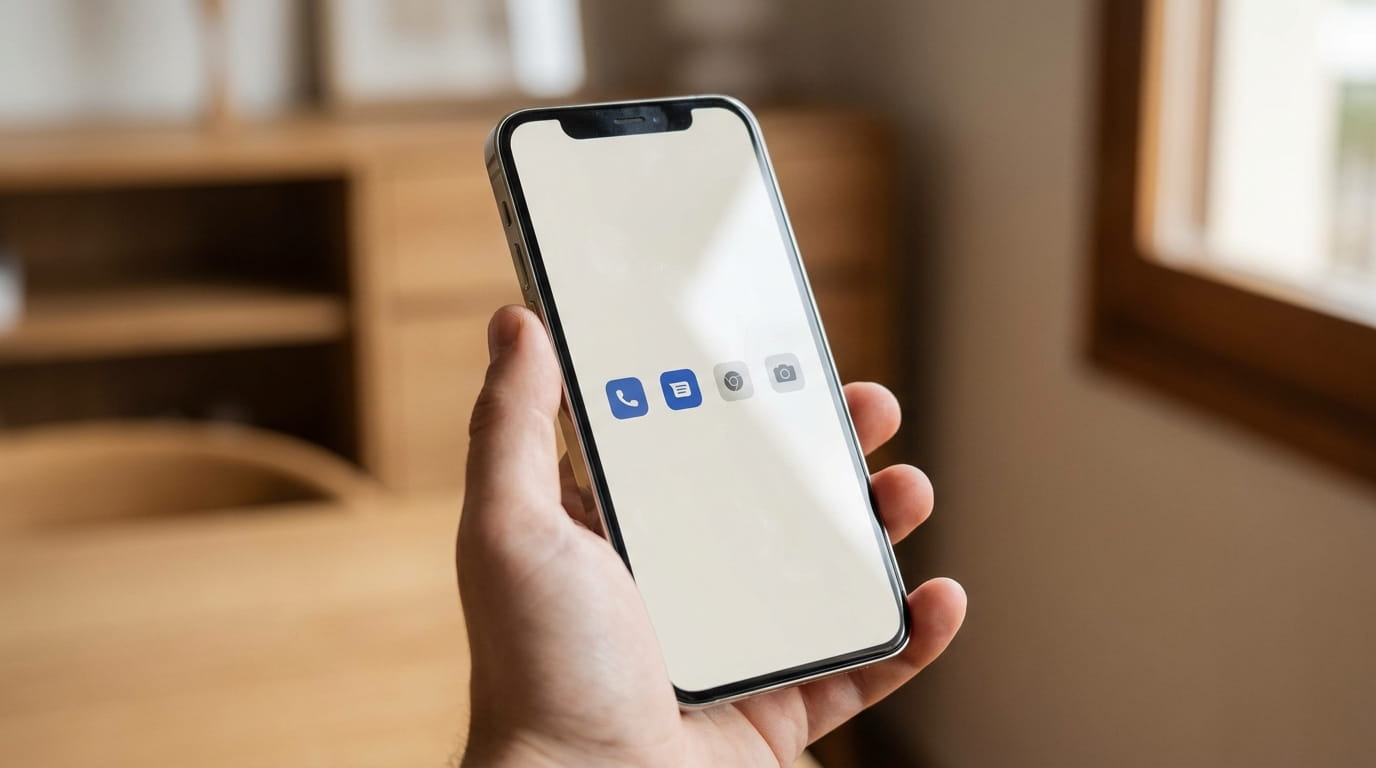
Your home screen is the first thing you see every time you unlock the phone, and a colorful grid of tempting apps is basically an invitation to get lost. So I made mine deliberately dull.
My home screen now has a handful of genuinely useful, non-distracting tools: maps, camera, calendar, notes, messages. The fun stuff is buried a couple of pages deep. When I unlock my phone to do a specific thing, I do that thing and I'm not ambushed by a wall of bright icons begging to be tapped.
I also tried switching the whole screen to grayscale, and honestly, it helps more than it has any right to. Color is part of what makes apps feel rewarding, and a gray screen is just less fun to stare at. I don't keep it on all the time, because some things genuinely need color, but I'll flip it on during stretches when I want my phone to be a tool and nothing more. A boring phone is a phone you put down.
Physical distance does the rest
The last piece is the simplest and maybe the most powerful: where the phone physically is. A phone within arm's reach gets picked up. A phone in another room doesn't.
So during focused work, the phone goes in a drawer or another room entirely. Not face down on the desk, where I can still see it and feel its gravitational pull, but genuinely out of sight. The few seconds it takes to go fetch it are usually enough for me to realize I didn't actually need it.
I've extended this to a couple of times and places by default. The phone doesn't come to the dinner table, and it doesn't charge next to my bed, because the first and last thing I do each day shouldn't be staring into a screen. Those two small rules alone reclaimed a surprising amount of my attention.
None of this is heroic. I still use my phone plenty, and some days I slip back into the old picking-it-up tic. But the baseline has shifted. By turning off the buzzing, adding a little friction, dulling the home screen, and keeping the thing at arm's length, I made my phone calm again without giving up anything I actually wanted. That, for me, beat going cold turkey by a mile.