 Expertspost

Chronic procrastinators usually assume they have a character flaw. The research says otherwise. Psychologist Fuschia Sirois of Durham University, who has studied procrastination for over two decades, summarizes it bluntly in an APA Speaking of Psychology interview: procrastination is driven by emotions, not by laziness or poor time-management skills. People don't avoid the task; they avoid the negative feeling attached to the task — confusion, boredom, fear of doing it badly.
That diagnosis matters because it predicts which fixes work. Tools that reduce the bad feeling, or that route around the need for motivation entirely, hold up well in studies. Tools that add pressure mostly make things worse. Here is the practical version of both lists.
It isn't laziness
The tell is specificity. Most procrastinators are perfectly capable of working hard for hours on tasks they find engaging. The avoidance targets particular tasks, and those tasks almost always carry something uncomfortable: they're vague, they invite judgment, or they're simply tedious. Vague is the worst offender — "plan the project" is not something anyone can start, so nobody starts it, and then feels bad about not starting a thing that was never startable.
Sirois's research also documents real costs to leaving this unaddressed: chronic procrastination correlates with higher stress, anxiety, depression, and even elevated cardiovascular risk — her research overview collects the evidence. Avoidance delivers a genuine short-term mood boost, which is exactly why it's reinforcing and why willpower alone rarely breaks the loop.
The most useful immediate habit is naming the feeling. Caught drifting toward a low-stakes distraction? Ask what about the avoided task is uncomfortable. "I don't actually know how to begin" is a solvable problem. "I'm a lazy person" is just a story, and not a useful one.
The emotion-regulation framing also explains what reliably doesn't work: waiting to feel motivated (the feeling arrives after starting, not before), harsher deadlines and guilt (they add negative emotion to a task being avoided precisely because of negative emotion), and dramatic all-or-nothing productivity overhauls (which collapse on the first bad day and add a new failure to feel bad about).
Shrink the first step
Most procrastination weakens dramatically when the next step is small and concrete enough that starting feels almost silly to refuse. "Write the report" is a wall. "Open a blank document and type the title" is a step.
- "Taxes" becomes "find last year's return in email."
- "Plan trip" becomes "list three cities to consider."
- "Fix the budget" becomes "open the spreadsheet and look at one number."
This works on the emotional mechanism directly: a tiny step carries almost none of the threat of the full task, so there's less feeling to avoid. Writing tasks as first physical actions is also the difference between a task list that gets used and one that radiates guilt — more on that in the weekly review and the task list it feeds.
A related move is the five-minute deal: commit to the task for five minutes with genuine permission to stop afterward. The permission has to be real — a fake five minutes stops working the moment the brain notices it's a trap for an hour of work — so sometimes you really do stop at five minutes, conscience clear. But most of the time, once started, continuing feels easier than stopping. Starting is most of the battle; the five minutes was never the goal, it was a door.
If-then plans: the most-tested fix
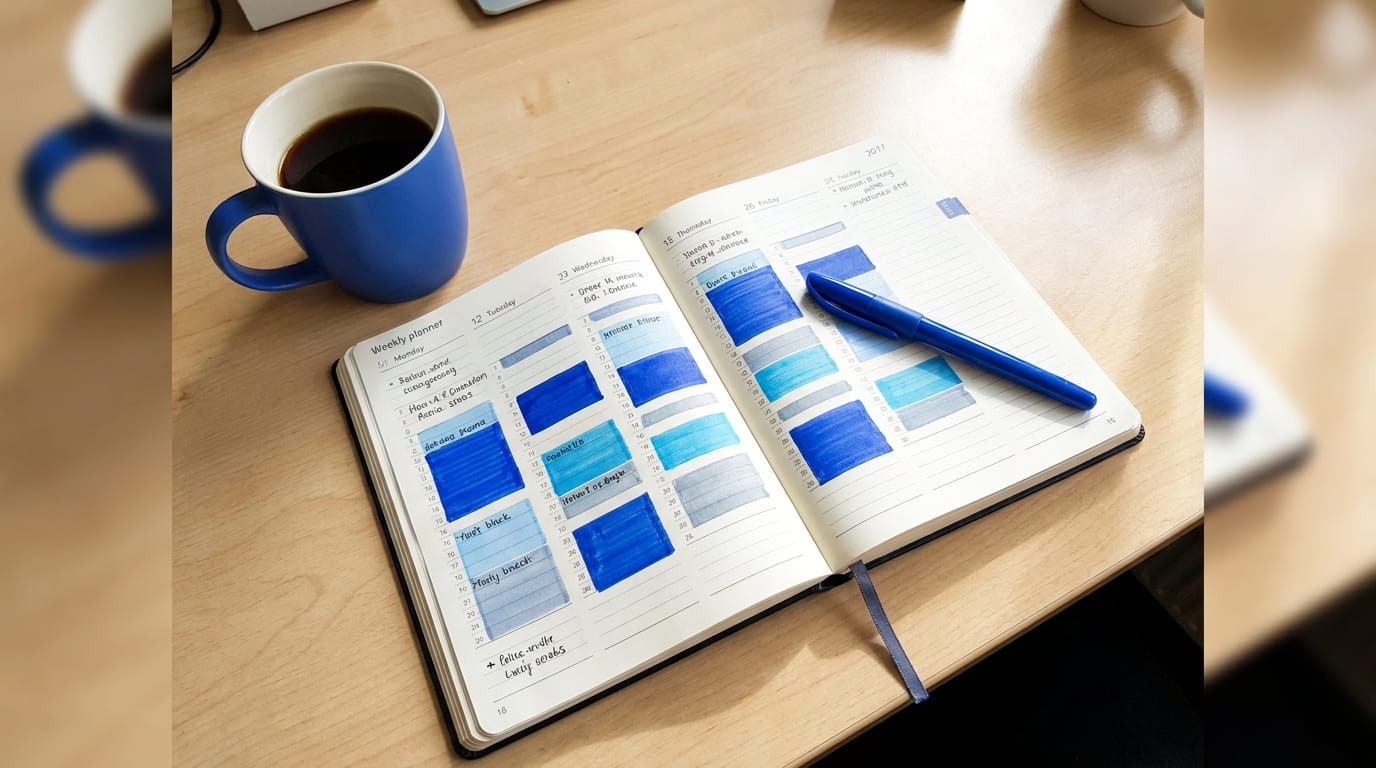
The best-evidenced anti-procrastination tool has an unglamorous name: the implementation intention, developed by psychologist Peter Gollwitzer in the 1990s. Instead of intending to "work on the proposal this week," you pre-decide the trigger: "When I sit down with coffee on Tuesday, I will open the proposal and write the summary paragraph."
An if-then plan moves the start decision from the worst possible moment — the moment of dread — to a calm moment in advance.
The evidence base is unusually deep. The National Cancer Institute's research overview summarizes work by Gollwitzer and Paschal Sheeran, including a meta-analysis of more than ninety studies finding a medium-to-large effect of if-then planning on goal attainment, across domains from exercise to studying.
Plan-making has a second, less obvious benefit. In a series of studies titled "Consider It Done!", E. J. Masicampo and Roy Baumeister found that unfinished tasks intrude on attention during unrelated work — but writing a specific plan for the unfinished task eliminated the intrusions, even though nothing had actually been done yet. A concrete plan quiets the nagging, which lowers the ambient dread that feeds avoidance.
Remove friction before it's needed
A lot of procrastination is triggered by tiny obstacles encountered at the exact moment motivation is lowest: the document isn't open, the materials aren't out, the file can't be found. Each small obstacle is an exit ramp.
The countermeasure is doing setup in advance, during a higher-energy moment. Open tomorrow's documents tonight and leave them open. Lay out the gym clothes. Put the book on the pillow. Future-you is a more tired, more easily derailed person; arrange the environment so the path of least resistance points toward the task instead of away from it.
The same logic applies in reverse to distractions: every temptation within arm's reach is a bet against willpower, and willpower loses often enough that the smarter play is removing the bet. Phones out of sight, time-sink tabs closed before they're needed as escape hatches. How to set that up properly is covered in the guide to getting an hour of real focus.
Why self-criticism backfires
The intuitive response to procrastinating is self-punishment, on the theory that guilt motivates. The research finds the opposite. Because procrastination is avoidance of negative feeling, piling guilt onto a task makes the task more aversive, which strengthens the avoidance. It's a spiral: avoid, feel guilty, find the task even more unpleasant, avoid harder.
Sirois's work points to self-compassion as the working alternative — and in her APA interview she highlights related findings that students who forgave themselves for procrastinating on one exam procrastinated less on the next one. Treating a procrastinated task as a neutral logistics problem ("this has been avoided for two days; what's the smallest next step, and what feeling is in the way?") drains the spiral of its fuel.
None of this is a cure. Everyone still loses the occasional afternoon to nonsense. But the combination — name the feeling, shrink the step, pre-decide the start, stage the environment, skip the self-flagellation — reliably reduces how often it happens and how long recovery takes. The fixes are boring. They also have something most productivity advice lacks: evidence.
Frequently asked questions
Is procrastination the same as laziness?
No. Researchers define procrastination as voluntarily delaying a task despite expecting to be worse off — and the same people who procrastinate on one dreaded task often work intensely on tasks they enjoy. The driver is avoidance of a negative feeling attached to a specific task, not a general unwillingness to work. That's why effort-based fixes like "try harder" rarely help.
Do deadlines cure procrastination?
External deadlines compress the problem rather than solve it: work still happens in a stressed final sprint, and quality usually suffers. What helps more is converting a distant deadline into a series of concrete, scheduled next steps — an if-then plan for each — so the task generates many small start points instead of one looming wall.
What is the single most effective first move?
Shrink the next step until starting feels almost trivial, then tie it to a specific cue: "After lunch, I'll open the draft and write the title." This combines two well-supported mechanisms — reducing the task's emotional load and pre-deciding the start — and it works even on days when motivation is absent, which is exactly when a method needs to work.
Sources & further reading
- Why we procrastinate and what to do about it, with Fuschia Sirois, PhD (Speaking of Psychology) — American Psychological Association
- Procrastination research overview — Fuschia Sirois, Durham University
- Implementation Intentions (research construct overview) — National Cancer Institute
- Consider It Done! Plan Making Can Eliminate the Cognitive Effects of Unfulfilled Goals (Masicampo & Baumeister, 2011) — Journal of Personality and Social Psychology