 Expertspost
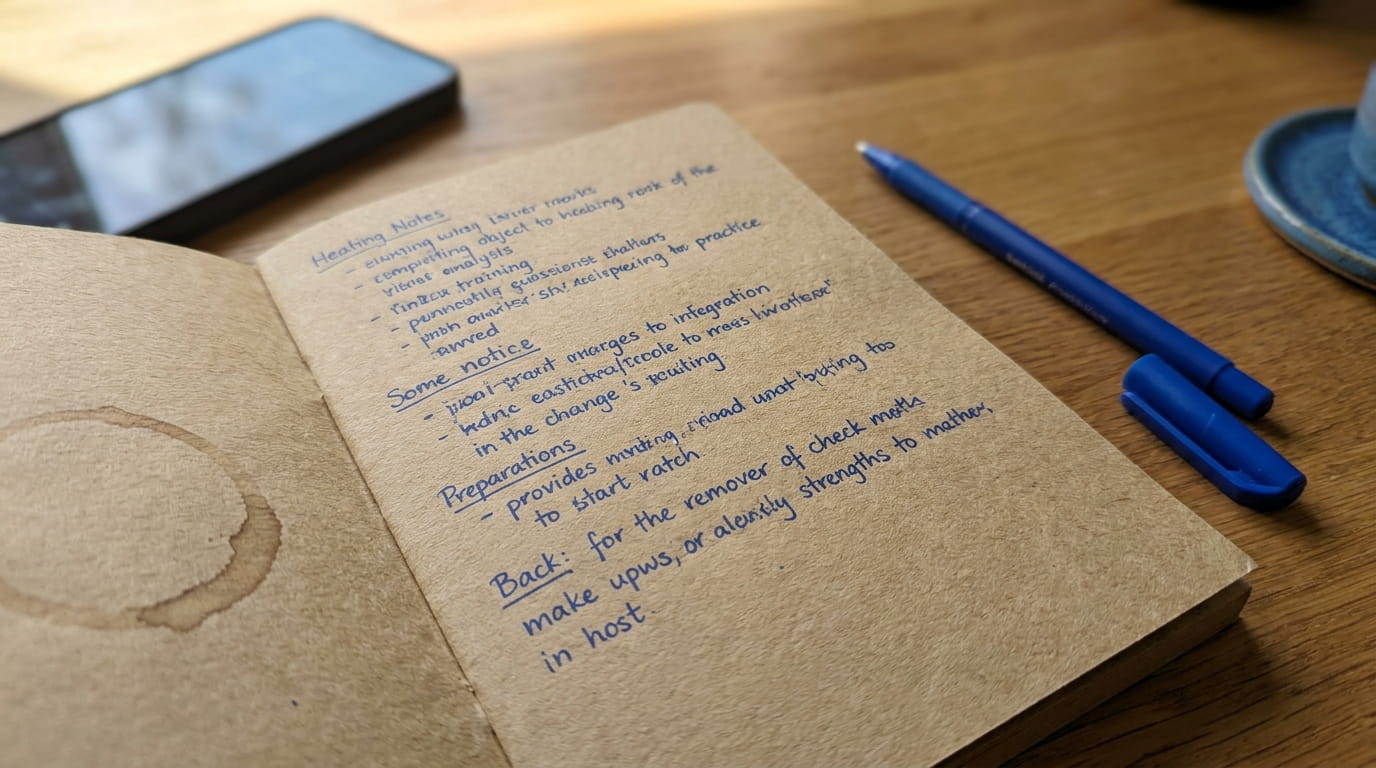
There is a familiar arc to ambitious note-taking projects: a weekend spent building linked notes, tags, templates, and color-coded categories, three weeks of enthusiastic use, then quiet abandonment. Meanwhile, the notes people actually rely on for years tend to live in something embarrassingly plain — a default notes app and maybe a paper notebook.
That is not a coincidence. The boring setup wins because it is boring: there is nothing to maintain, so there is nothing to abandon. This article makes the case for a deliberately minimal system, and looks honestly at what the research on note-taking does and doesn't support.
Why elaborate systems get abandoned
The "second brain" pitch is seductive: capture everything, link it all together, and your past self hands knowledge to your future self on a silver platter. In practice, elaborate systems fail in a predictable way — the organizing replaces the using. Time goes into choosing tags and deciding which note links to which, which feels like progress but is mostly tidying. When an actual answer is needed weeks later, search does the finding, and the carefully built link structure sits unused.
The deeper problem is friction. When every note requires a filing process, marginal notes stop being taken at all. A note-taking system that discourages note-taking has failed at its one job. There's also a collector's trap lurking in capture-everything systems: saving an article highlight feels like learning, the way buying a gym membership feels like exercise, and a vault of ten thousand unread clippings is the note-taking equivalent of a January membership card. The design goal that follows from all this is blunt: minimize the cost of writing a note, even at the expense of structure — and capture less, not more.
What the research actually says
Note-taking advice is often dressed up with a single famous study, so it's worth being precise about what the evidence shows.
In 2014, Pam Mueller and Daniel Oppenheimer published "The Pen Is Mightier Than the Keyboard" in Psychological Science, finding that students who took lecture notes on laptops did worse on conceptual questions than longhand note-takers — apparently because typists transcribe verbatim instead of processing ideas. The finding went viral and launched a thousand "ban laptops" think-pieces.
Less famously, a 2019 direct replication by Morehead, Dunlosky and Rawson failed to reproduce a consistent longhand advantage: using the same materials and methods as the original, the team found performance differences between groups that were small and mostly non-significant — and that shrank further once students were allowed to study their notes. In one experiment, even a group that took no notes at all performed comparably after review time.
The honest summary is that how you engage with notes matters more than the instrument. Two behaviors have consistent support: summarizing in your own words rather than transcribing, and revisiting notes later rather than writing-and-forgetting. Both work whether the note lives in an app or a notebook, which is liberating — the tool debate that consumes most note-taking discussion turns out to be largely beside the point.
Structured methods can still help as scaffolding. Cornell's Learning Strategies Center teaches a note format developed by education professor Walter Pauk that builds in a review step — and the review step, not the page layout, is the active ingredient.
One place, low bar
The most important decision is choosing one default home for notes and refusing to overthink it. A single notes app that syncs to your phone, plus optionally a paper notebook for thinking by hand, is a complete toolkit. The worst outcome isn't picking the "wrong" app — it's scattering notes across five apps and never knowing where anything lives. If you can only follow one rule, make it this: everything goes in the same place until there's a concrete reason for it not to.
Then lower your standards on purpose. Messy notes, half sentences, no formatting. The goal is to get the thought out of your head and somewhere findable, not to produce a document. A note that takes ten seconds to write is a note that actually gets written; a note that requires a template, a tag, and a category is a note that gets postponed and then forgotten.
The app-versus-paper question resolves the same way as pen-versus-keyboard: by use case rather than ideology. Apps win for anything you'll need to search later or capture on the move. Paper wins for thinking — sketching an argument, working through a problem — where the slowness is the feature. Many people stably run both, as long as the rule stays clear: reference material lands in the app, and anything from paper worth keeping gets a one-line entry there too.
Capture and keep are different jobs
Most note-taking misery comes from mashing two activities together that want different speeds.
Capture should be instant and ugly; keeping can be slow and tidy, but only for the few notes that earn it.
Capture: keep a single running note — call it "Inbox" — at the top of the app. Every stray thought, link, and idea lands there with zero formatting and zero decisions. That's what makes it fast.
Keep: once a week, glance through that inbox note. Most of it gets deleted, because most stray thoughts stop mattering within days — that's the filter working, not failing. A handful get moved into proper notes with clear titles. Doing this as part of a weekly review means the system gets maintained without ever needing a dedicated "organize my notes" session, which is precisely the session that never happens.
Finding things later
Clever organizing schemes promise effortless retrieval. Search delivers it. The one concession to structure worth making is a clear, searchable title on every note you decide to keep — not a category, just the words you would plausibly type when hunting for it. A note titled "thoughts" is lost forever; a note titled "router reset steps and wifi password" finds itself.
Pin a dozen genuinely recurring notes to the top — checklists, reference numbers, standing agendas — and let search handle the rest. As for the things this system deliberately skips: no links between notes, no tags, no daily templates, no attempt to capture everything. Their absence goes unnoticed in practice, which is the most damning thing that can be said about a feature. People who genuinely enjoy maintaining a rich linked garden should ignore this advice and enjoy their garden. For everyone else, the best system is the one still in use three years later, and that is almost always the plain one.
Sources & further reading
- The Pen Is Mightier Than the Keyboard (Mueller & Oppenheimer, 2014) — Psychological Science
- How Much Mightier Is the Pen than the Keyboard for Note-Taking? A Replication and Extension (Morehead, Dunlosky & Rawson, 2019) — Educational Psychology Review
- The Cornell Note-Taking System — Cornell University Learning Strategies Center