 Expertspost

Productivity systems fail on a schedule. A new app or method works for a few weeks while it's fresh, then decays — tasks pile up unreviewed, the calendar drifts from reality, commitments made in hallways go unrecorded — until one Monday the whole thing is fiction and gets abandoned. Then a new system, a fresh start, and the same cycle. The missing ingredient is rarely a better system. It's maintenance.
The weekly review is that maintenance: a short, scheduled session — twenty minutes is enough — to catch the small slips before they become a pile-up. It is the least glamorous practice in all of productivity and arguably the highest-value one. This guide covers why it works, the exact checklist, and the task-list habits that make the review worth doing.
Why a review works at all
The weekly review is most associated with David Allen's Getting Things Done methodology, where it's the keystone habit — the thing that keeps every list trustworthy. Allen's slogan, "your mind is for having ideas, not holding them," turns out to have empirical support.
In a series of experiments published as "Consider It Done!" in the Journal of Personality and Social Psychology, E. J. Masicampo and Roy Baumeister showed that unfulfilled goals actively intrude on unrelated work: participants with unfinished tasks had more intrusive thoughts during a reading task and performed worse on unrelated problems. The striking part is the fix. Simply writing a specific plan for the unfinished goal eliminated the interference — without any of the work actually being done. The mind doesn't demand completion; it demands a credible plan.
That is precisely what a weekly review manufactures: a credible plan for everything currently open. Each stalled task gets a next step, each commitment gets a slot, and the mind — finally convinced that the system has the matter in hand — stops raising it at 2 a.m. The payoff is doubly invisible: the problems that don't happen, and the background mental nagging that quiets down. Nobody gets credit for the fire that never started, which is exactly why this habit needs a fixed slot on the calendar rather than goodwill.
There's no philosophy in any of this, just maintenance — the same logic as checking the oil instead of waiting for the engine to seize. The review doesn't make anyone more disciplined or more ambitious. It just keeps the tools honest enough to keep using.
The 20-minute checklist
The review is the same five steps every week, written down so none of it has to be remembered. With rough timings:
| Step | What it covers | Time |
|---|---|---|
| 1. Clear the capture points | Email to a calm state, notes inbox emptied, stray paper dealt with | 5 min |
| 2. Prune the task list | Cross off the done, delete the dead, rewrite anything vague | 5 min |
| 3. Look back | What finished, what stalled, and why — noticing, not judging | 3 min |
| 4. Look ahead | Scan next week's calendar, flag anything needing prep | 5 min |
| 5. Pick Monday's focus | One concrete first task, so the week starts pointed somewhere | 2 min |
A few notes on the steps. Step 1 leans on having few capture points to clear — a single notes inbox and an email inbox processed with a simple routine (see how to get your inbox under control); the fewer places things land during the week, the faster this goes. Step 2 is where most of the value lives: the rewrite of vague items is what keeps the list startable, and the deletions are what keep it short enough to face. Step 3 stays at three minutes deliberately — it's a temperature check, not a retrospective; if something stalled for the second week running, that's a signal the task is mis-phrased or doesn't actually matter, and either is useful to know.
Step 4 is forward defense: spotting on Friday that Thursday's presentation needs slides means the prep gets a calendar slot instead of becoming a Wednesday-night emergency. And step 5 is a miniature implementation intention — deciding Monday's first move on Friday means Monday morning starts with action instead of deliberation.
Most weeks the whole thing fits comfortably in twenty minutes, for a reason worth noticing: doing it weekly means there's never much mess to clear. The review stays short because it happens; skip three weeks and the backlog makes the next one miserable, which makes skipping more tempting, which is the decay spiral in miniature.
The task list the review feeds
A weekly review is only as good as the list it maintains, and most task lists die of three diseases: they grow too long to face, the entries go vague, and there's no daily relationship with them. The review treats the first two; the daily habits below treat the third. Together they're the difference between a list that runs the week and a list that radiates guilt.
Write tasks as first physical actions. "Website" is a topic, not a task — written by someone who knew what they meant and forgotten by the time they read it again. "Email the designer about the homepage draft" is a task: there's no thinking left between reading it and starting it. Every entry that requires figuring out what the task even means is a small planted moment of friction, and friction is where avoidance starts; the research on this is covered in what actually helps against procrastination. Rough rules: start with a verb, make it concrete enough that a tired person could begin without thinking, and if it's really a multi-step project, list only the next step and park the project elsewhere.
Run a short daily list. Separate "everything that might ever get done" from "what's happening today." Each morning — or better, the evening before — pull three to five items onto a daily shortlist. A list that can actually be finished produces a clean win and teaches trust; a forty-item scroll that can never be finished teaches only that lists are a source of failure. On days when the shortlist is done early, pull another item or two and enjoy being ahead; on days when it isn't finished, the unfinished items roll forward consciously rather than rotting in place. Either way, the master list never has to be confronted whole during the workday — that confrontation happens exactly once a week, on schedule, with a timer running.
A to-do list you can actually finish teaches you to trust it; one you never finish teaches you to ignore it.
Keep one capture habit and one parking lot. Everything that isn't for today needs somewhere trusted to live, or the brain keeps rehearsing it — the Masicampo and Baumeister finding again, in daily-life form. Capture stray tasks and ideas the moment they appear, into one place, with zero formatting. Keep a separate "someday/maybe" pile for ideas with no deadline; it's allowed to be huge and messy because it's a parking lot, not a promise. The weekly review is what keeps both honest: capture gets emptied, the parking lot gets skimmed, and the master list gets pruned before it bloats.
Keeping it to 20 minutes
The most common way weekly reviews die is by ballooning. A twenty-minute checkup turns into a two-hour reorganization festival — new tags, new categories, a better app — and nobody protects two dreaded hours on a Friday for long.
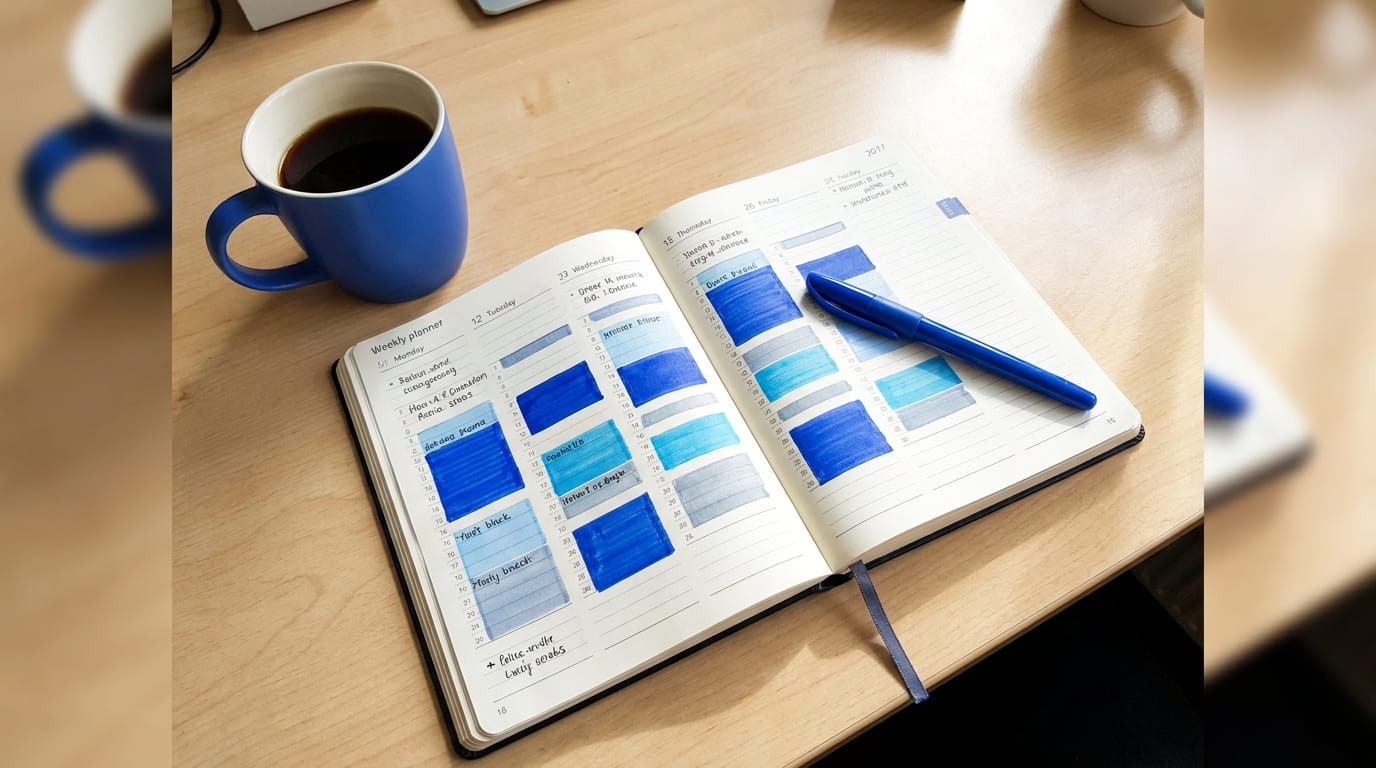
Set a timer for twenty minutes — a real timer, visibly counting — and stop when it rings, imperfect or not. The point is the regular light touch, not the deep clean. Anything that genuinely needs reorganizing becomes its own task on another day instead of hijacking the review. The timebox also prevents over-planning: the review establishes the shape of next week — its big two or three outcomes — and leaves hour-by-hour choreography to each morning, where it belongs. A Friday guess about Wednesday afternoon is fiction anyway; pairing the review with a loose time-blocking approach covers the daily layer.
What happens when it's skipped
Skipped reviews produce remarkably consistent symptoms, usually visible by the following Wednesday: the task list fills with stale, vague items and stops being consulted; small commitments made in passing slip through the cracks; and a low background anxiety sets in — the feeling of forgetting something, which is exhausting and usually accurate. The whole week takes on the texture of constantly reacting rather than choosing what happens next.
That anxiety isn't a character flaw; it's the predicted result of open loops without plans, per the research above. The mind keeps rehearsing unplanned commitments at unhelpful moments — usually around 11 p.m. — because rehearsal is the only tracking mechanism it has left once the written system goes stale. Which makes the trade explicit: one missed twenty-minute review buys a vaguely stressful week. Seeing the trade clearly is the best motivation to protect the slot.
And when a skip happens anyway — travel, illness, a deadline crunch — the recovery rule is the same as for email: don't schedule a heroic catch-up session. Run one normal-length review, accept that step 2 will be mostly deletions this time, and resume the rhythm the following Friday. The system is designed to bend; a missed week dents it without breaking it, and knowing that removes the perfectionism that kills most habits.
Making it a habit that survives
Reviews that survive long-term tend to share four design choices:
- A fixed slot tied to a cue. "Friday, right after the last meeting" beats "sometime Friday." This is an implementation intention — an if-then plan of the kind the National Cancer Institute's research overview credits with medium-to-large effects on follow-through across more than ninety studies.
- A written checklist, so no step has to be recalled and "done" has a definition.
- A hard time limit, so it never becomes a dreaded project.
- A small reward attached — a good coffee, the satisfaction of a clean close to the week. Psychologist Fuschia Sirois's work on task avoidance, summarized in her APA interview, is a reminder that tasks carrying pleasant associations get avoided less; that applies to maintenance rituals too.
Once the weekly rhythm is stable, a lightweight monthly variant is worth adding: same checklist, plus ten extra minutes to skim the someday/maybe parking lot and ask whether any project on the master list should be killed outright. Killing projects deliberately, rather than letting them haunt the list for a year, is one of the most underrated moves in personal productivity — every zombie project removed makes the remaining list more believable.
One last permission: adapt the checklist freely. The magic isn't in these particular five steps — it's in stopping once a week to look at the week before it looks at you. Twenty minutes, a timer, a coffee. The cheapest insurance in productivity.
Frequently asked questions
When is the best time for a weekly review?
Late Friday afternoon has two advantages: the week is fresh in memory, and closing open loops before the weekend measurably reduces the Sunday-evening dread of half-remembered obligations. Monday morning works too, as planning momentum for the week. The honest answer is that the best time is whichever slot you will actually keep — consistency beats optimization here.
Paper or app for the task list?
Both work; the maintenance habit matters far more than the medium. Paper adds useful friction — rewriting a task list weekly forces the prune that apps let you skip. Apps win on capture-anywhere and recurring tasks. A common stable hybrid: an app as the master list and parking lot, paper for the daily shortlist of three to five.
What if a review keeps getting skipped?
Shrink it before abandoning it. A ten-minute version — clear capture points, prune the list, pick Monday's focus — preserves most of the value. Also check the trigger: a review without a fixed slot and cue ('Friday, after the last meeting, with coffee') relies on remembering, and remembering is exactly what busy weeks are worst at.
Is a daily review needed too?
A heavyweight daily review is overkill, but a two-minute daily shutdown pairs beautifully with the weekly one: glance at the calendar for tomorrow, pick the first task, close the loops you can. The weekly review keeps the system honest; the daily shutdown keeps the next morning frictionless. Together they cover both scales without much ceremony.
Sources & further reading
- Getting Things Done — official site — David Allen Company
- Consider It Done! Plan Making Can Eliminate the Cognitive Effects of Unfulfilled Goals (Masicampo & Baumeister, 2011) — Journal of Personality and Social Psychology
- Implementation Intentions (research construct overview) — National Cancer Institute
- Why we procrastinate and what to do about it, with Fuschia Sirois, PhD — American Psychological Association