 Expertspost
A mattress spends eight hours a night absorbing sweat, body heat, and shed skin, and most of them never get cleaned once in a decade of service. The good news is that a proper deep clean is a forty-minute job built around two cheap tools — a vacuum and a box of baking soda — and it only needs doing a couple of times a year. This guide covers the routine, the stain triage, the schedule, and the honest limits of what cleaning can fix.
Why a mattress even needs this
You lose a surprising amount of moisture every night through sweat and breathing, and you shed skin cells continuously. That combination is exactly what dust mites live on. According to the American Lung Association, dust mites are one of the most common indoor allergy triggers, they concentrate in bedding and mattresses, and the proteins in their droppings can aggravate allergies and asthma year-round. A mattress that never gets vacuumed becomes a reservoir for exactly the stuff a stuffy-nosed sleeper is reacting to.
There is also a plainer comfort argument. A mattress that holds old moisture smells faintly stale, and because you live with it, you stop noticing — the way you stop noticing your own home's smell. The first night on a freshly cleaned, fully aired-out bed with hot-washed sheets is noticeably nicer, which is reason enough for a twice-yearly ritual even before the allergy case.
Dust mites need two things to thrive: moisture and food, and a slept-in mattress supplies both nightly. That is why the routine below leans so hard on drying — the baking soda, the airing out, the morning covers-back habit. Starve the mattress of trapped humidity and you make it a far worse home for the things you are allergic to, which is a quieter win than any stain removal.
Be clear-eyed about what cleaning does not do, though. It will not fix sagging, body impressions, or foam that has packed down and stopped supporting you. Those are structural problems, and we cover the replacement question at the end. Cleaning fixes smells, allergens, and surface grime — nothing more.
The basic deep-clean routine
Set aside a morning, because the waiting is built in: ten minutes of stripping, fifteen of vacuuming, a few hours of baking soda doing its quiet work while you do anything else, and ten minutes of cleanup. Start by stripping everything, including the mattress protector if you use one, and washing it all on the hottest setting the care labels allow. Heat matters here: the American Lung Association recommends washing bedding weekly in water of at least 120°F, because hot water is what actually kills dust mites rather than just rinsing past them.
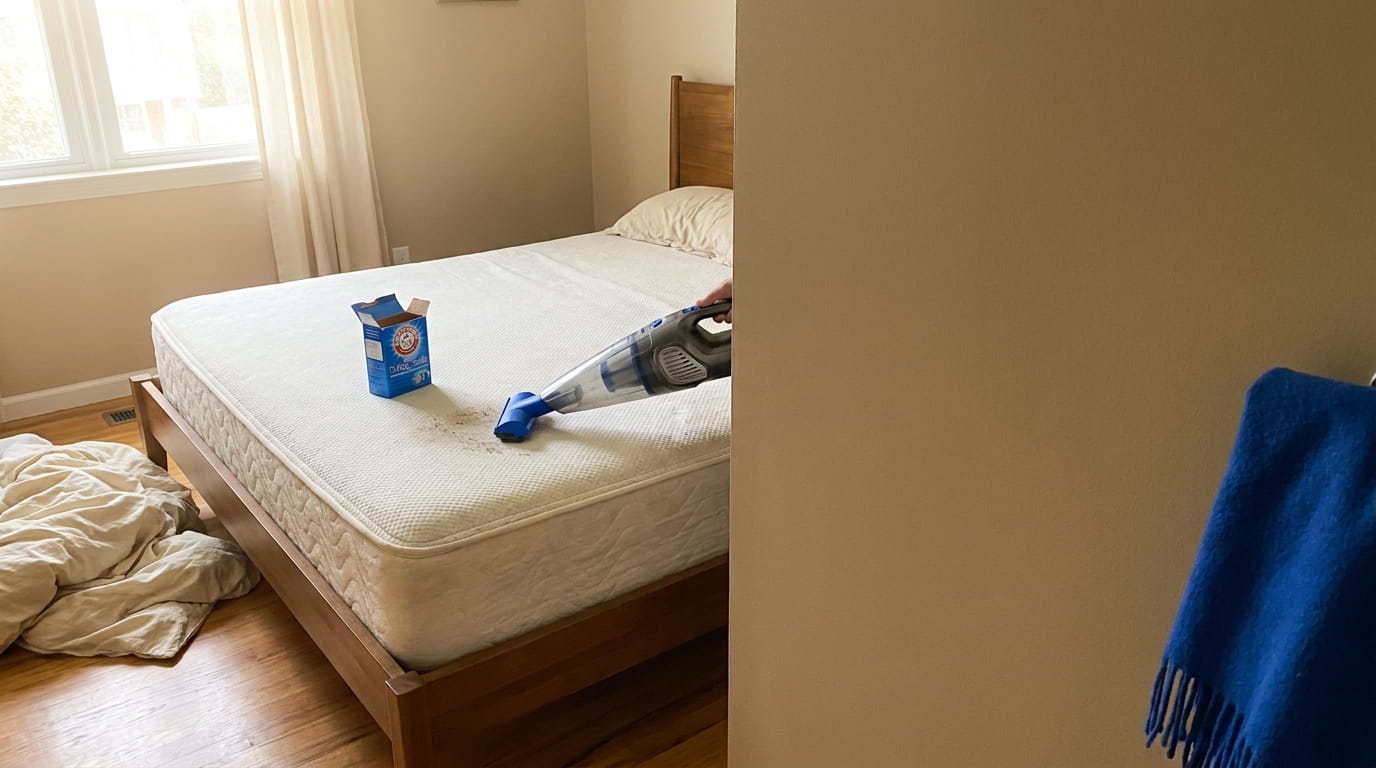
Then the mattress itself, following the same sequence the Sleep Foundation's cleaning guide lays out:
- Vacuum the entire surface with the upholstery attachment, slowly. Press into seams and piped edges, where dust and skin debris collect. This single step removes most of what you care about.
- Sift a thin, even layer of plain baking soda over the top. A flour sifter or colander spreads it evenly; do not dump it in piles.
- Leave it for at least a few hours. Baking soda needs time to absorb moisture and neutralize odor — an all-day sit is better than a token twenty minutes.
- Vacuum it all back up, just as slowly as the first pass.
If the weather allows, open a window while the baking soda works. Airflow does as much for a stale mattress as the powder does. On a dry day, propping the mattress on its side against a wall for an hour lets air reach the underside, which never breathes in normal use.
While the baking soda sits, deal with the rest of the bed. Most pillows — down and synthetic alike — are machine-washable on a gentle cycle if the care tag agrees; wash two at a time to balance the drum, and dry them completely, fluffing with dryer balls, because a damp pillow core grows mildew quickly. Duvets and comforters usually take a trip through a large-capacity machine once or twice a season. And run the vacuum over the bed base, the headboard, and the floor underneath while everything is stripped — dust under the bed migrates straight back up otherwise.
The vacuum does the heavy lifting; the baking soda just handles the smell.
Dealing with stains and smells
The cardinal rule: use as little liquid as possible, and blot rather than rub. A mattress interior never fully dries once soaked, and trapped moisture is how mildew starts inside foam. Everything below is a damp-cloth operation, not a soaking one.
For general dinge and old sweat marks, mix equal parts cool water and white vinegar in a spray bottle, mist the spot lightly, and blot with a clean towel until it lifts. For protein stains — blood, urine, and other biological accidents — an enzyme cleaner of the kind sold for pet messes outperforms soap, because it breaks the stain down chemically instead of pushing it around. Apply a small amount, wait the contact time printed on the bottle, blot, then go over the spot once with plain water and blot dry.
Hydrogen peroxide works on stubborn protein stains but can lighten colored ticking, so test it on a hidden corner first. For pet accidents and children's nighttime mishaps, the enzyme cleaner is non-negotiable — soap masks the odor briefly, while the enzymes actually digest the compounds that draw a pet back to the same spot. Work from the outside of the stain inward so you do not enlarge it, and be patient: two light passes with full drying between beat one heavy soaking.
The same fast-action logic that governs clothing applies here too — a spill blotted within seconds usually leaves nothing, while one that soaks for ten minutes leaves a permanent shadow. Keep an old towel within reach of the bed if coffee or tea regularly travels there. The broader playbook is in our guide to removing the stains you actually get.
Moisture is the real enemy
Skip steam cleaners and upholstery shampoos on foam and hybrid mattresses. Steam forces water deep into layers with no airflow, and the Sleep Foundation specifically cautions against saturating memory foam for exactly this reason. Dry methods are slower, but they can never grow mold inside the mattress, and that trade is worth making every time.
After treating any wet spot, point a fan at it for a couple of hours and do not remake the bed until the area feels completely dry and room-temperature to the back of your hand — a cool-feeling patch means water is still evaporating. A cheap habit that helps daily: fold the covers back for twenty minutes each morning instead of making the bed immediately. That lets the night's moisture escape rather than trapping it under a duvet.
How often is actually worth it
Nobody needs to baking-soda a mattress monthly. The schedule below combines the Sleep Foundation's recommendation of a full clean roughly every six months with its guidance on washing sheets weekly — more often if pets share the bed or allergies are in play.
| Task | How often |
|---|---|
| Wash sheets | Weekly (every 3-4 days with pets in the bed) |
| Vacuum the mattress surface | Every 2-3 months |
| Full baking-soda deep clean | Every 6 months |
| Wash mattress protector | Every 1-2 months |
| Rotate head to foot | Every 3-6 months |
Rotation matters more than people think, especially when two sleepers of different weights share the bed, because it spreads the wear instead of carving a trench on one side. Note that most modern foam and hybrid mattresses are one-sided: rotate them end to end, but do not flip them unless the manufacturer says the mattress is double-sided.
Add pillows to the rotation too — wash them two to four times a year and replace them every year or two once they stop springing back, since a folded-in-half pillow that stays folded has finished its career. None of this needs a calendar reminder beyond pairing tasks: vacuum the mattress when you flip the protector into the wash, rotate it at the deep clean, and the schedule runs itself.
The cheap thing that saves you the work
A washable mattress protector is the single best small purchase for a bed, typically $20-40 for a queen. Modern fabric-backed protectors are quiet and breathable — nothing like the crinkly plastic covers of childhood — and with one in place, almost nothing reaches the actual mattress. Spills, sweat, and allergens stop at a layer you can peel off and run through a hot wash, which converts most future "mattress cleaning" into ordinary laundry.
Protector styles differ enough to matter. A waterproof-membrane protector is the right call for households with kids, pets, or bedside coffee, and modern polyurethane membranes are quiet and do not sleep hot the way vinyl did. A simple quilted cotton protector breathes best but only handles dust and sweat, not spills. For allergy sufferers, the American Lung Association goes a step further and recommends zippered allergen-proof encasements for both mattress and pillows, which seal dust mites out of the places they most want to colonize. Either way, the protector plus the weekly hot wash for sheets is the maintenance system; the deep clean is just the twice-yearly reset.
When cleaning will not help
No amount of baking soda revives a mattress that has structurally failed. The Sleep Foundation puts the typical mattress lifespan at seven to ten years, depending on materials, body weight, and how well it has been supported on its frame. Visible sagging, a permanent body impression, springs you can feel, or new aches that fade when you sleep elsewhere are all signs the support is gone, not the cleanliness.
Before blaming the mattress, check what it sits on. A sagging box spring, a frame missing a center support, or slats spaced too far apart will hammock even a healthy mattress — and using the wrong base is a common way to void a mattress warranty, so it is worth reading the fine print before writing the mattress off. Fixing a $40 support problem is considerably cheaper than replacing a $1,000 mattress that was never the culprit.
If the mattress is mid-life and merely tired, clean it, rotate it, and put a protector on it. If it is past the decade mark and you wake up sore, spend the cleaning afternoon shopping instead. And when the new one arrives, start it on the schedule above from day one — a protector from the first night and a six-month deep clean keep it from ever reaching the stage that made you search for this article. If floor space around the bed is part of the problem, under-bed bins and the rest of our small-space storage ideas pair naturally with a freshly reset bedroom.
Frequently asked questions
How long should baking soda sit on a mattress?
Longer than most guides suggest. The Sleep Foundation recommends leaving it for at least a few hours; starting in the morning and vacuuming in the late afternoon gives the powder time to absorb both moisture and odor. A quick twenty-minute sprinkle mostly just gives you more vacuuming to do.
Can you steam-clean a memory foam mattress?
It is risky. Steam drives moisture into foam layers that have no airflow, and damp foam can develop mildew from the inside out. Stick to dry methods — vacuuming and baking soda — and treat stains with as little liquid as possible, drying each spot thoroughly with a fan afterward.
Should a mattress be flipped or rotated?
Most modern foam and hybrid mattresses are one-sided and should only be rotated head to foot, every three to six months. Flipping is for older two-sided innerspring models. Check the manufacturer's care tag before wrestling the mattress over; flipping a one-sided model puts your weight on a layer never designed to be slept on.
How hot does water need to be to kill dust mites?
The American Lung Association recommends washing bedding weekly in hot water of at least 120°F (49°C). Cooler washes still remove allergen-carrying dust, which helps, but the heat is what actually kills the mites. Drying on a hot cycle adds a second round of heat for anything that survived the wash.
Sources & further reading
- How to Clean a Mattress — Sleep Foundation
- Dust Mites — American Lung Association
- How Often Should You Wash Your Sheets? — Sleep Foundation
- How Long Should a Mattress Last? — Sleep Foundation