 Expertspost
Energy-saving advice is a genre with a quality-control problem: half the standard tips change nothing a household will ever see on a statement. This guide sticks to the fixes with measured numbers behind them — Department of Energy estimates, Energy Star field data — ranked roughly by impact, with the overrated advice called out at the end so you can skip it with a clear conscience.
Find where the money goes first
Before buying anything, know what is actually eating your power. For a typical American household, Energy Star estimates that almost half the annual energy bill goes to heating and cooling — more than $900 a year — with water heating the usual runner-up and lighting and gadgets far behind. That hierarchy should drive your spending: a dollar aimed at heating and cooling works several times harder than a dollar aimed at electronics.
The Department of Energy recommends a home energy assessment as the first step before paying for upgrades. A professional assessment — often free or discounted through your utility — uses blower doors and infrared cameras to show exactly where conditioned air escapes, and a diligent DIY walk-through can pinpoint the worst leaks for nothing. Even without an audit, twelve months of past bills are a free diagnostic: a summer spike means cooling is your problem, a winter spike points at heating, and a flat year-round line suggests the water heater or an always-on appliance. A plug-in power meter, around $20-30, settles any argument about a specific device — plug it in for a week, read the kilowatt-hours, multiply by your rate. Aging garage refrigerators are the classic offender this test catches, quietly costing more per year than the convenience is worth.
The hierarchy also tells you what this article deliberately leaves out: insulation. Adding attic insulation is one of the highest-return upgrades in a poorly insulated house, but it is a bigger-ticket project that deserves the audit first, so the blower-door numbers tell you whether the attic, the walls, or the ducts are the real hole. Everything below is the cheap, fast tier — the fixes worth doing in any home before spending serious money.
Seal the air leaks
Sealing leaks is the unglamorous workhorse of home efficiency. The Department of Energy calls caulking and weatherstripping two of the most cost-effective fixes available, with the investment typically paying for itself in a year or less. Cold air sneaks in around window frames, door jambs, baseboards, attic hatches, and the holes where pipes and cables enter the house, and your heating system fights that infiltration all day long.
Finding the leaks is half the job, and the DOE's DIY method works: on a windy day, move a lit incense stick or a damp hand around window frames, outlet plates, the attic hatch, and the fireplace damper, and watch for the telltale waver or chill. The usual suspects ranked by severity: the attic hatch (often completely unsealed), the fireplace damper left open year-round, gaps around plumbing under sinks, and the quarter-inch of daylight under exterior doors.
The work itself is a weekend of caulk gun and weatherstrip rolls: caulk the fixed joints, weatherstrip the moving parts, add a door sweep where daylight shows under an exterior door, and use childproof outlet gaskets on exterior-wall outlets that leak a thin, steady draft. None of it requires skill beyond patience, and unlike most efficiency upgrades, the materials cost tens of dollars rather than hundreds.
Schedule the thermostat
Because heating and cooling dominate the bill, the thermostat is the single most powerful dial in the house. The Department of Energy estimates you can save as much as 10 percent a year on heating and cooling by turning the thermostat back 7-10°F from its normal setting for 8 hours a day — which maps neatly onto sleeping hours, working hours, or both. Its winter guideline is around 68-70°F while you are awake and at home, lower while you sleep or are out; in summer, let the house run warmer when empty.
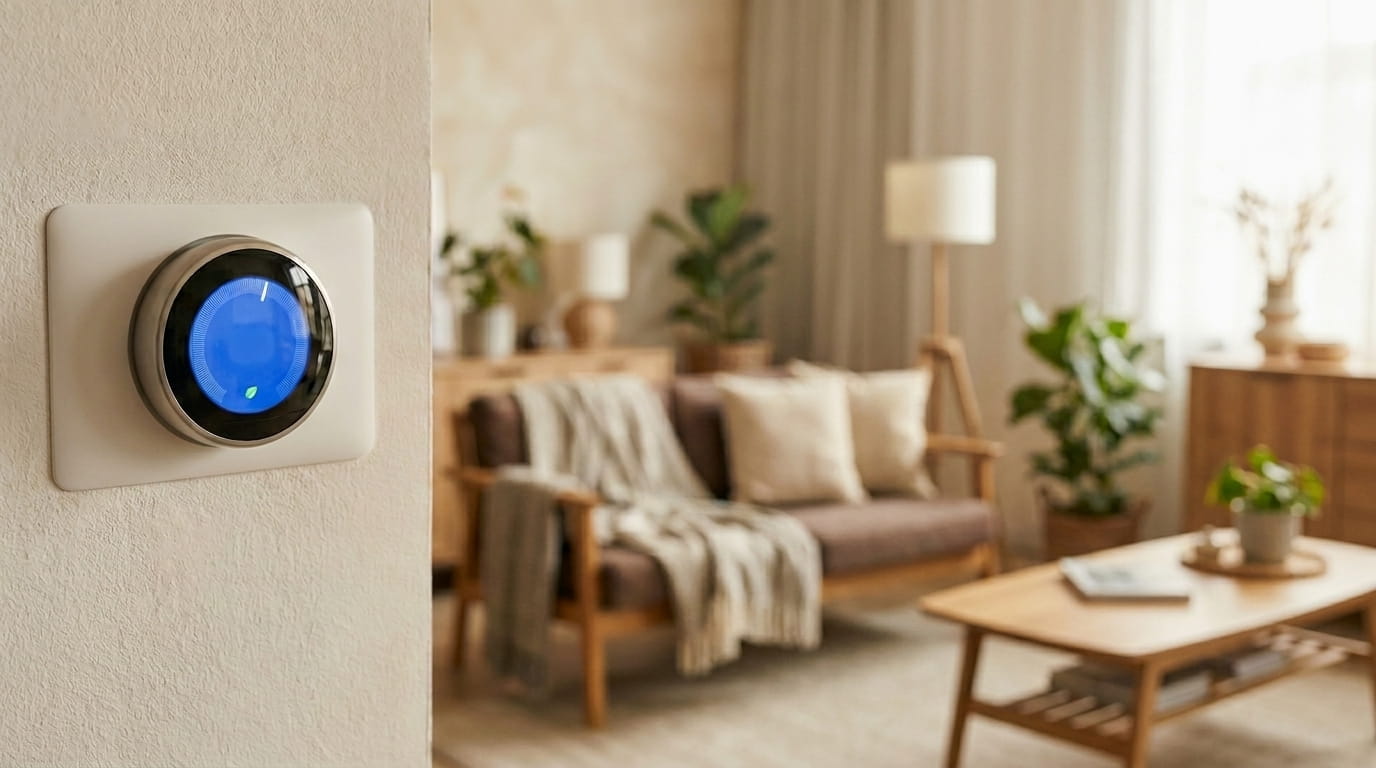
A basic programmable thermostat handles the schedule if you set it up and leave it alone. A smart thermostat does the same job without depending on your memory, learns your patterns, and adjusts when the house is empty; Energy Star certifies models based on actual field savings data rather than lab claims, so the certification is worth checking before you buy. If you are wiring one in yourself, note that it is one of the few genuinely useful smart-home devices that needs no monthly fee — a theme we expand in building a smart home without subscriptions.
Two cautions keep the strategy honest. With heat pumps, deep manual setbacks can backfire by triggering inefficient auxiliary heat on recovery — use a thermostat designed for heat-pump scheduling or keep setbacks modest. And space heaters are the reverse of a fix: resistance heating is expensive per unit of warmth, so a portable heater warming one room only saves money if the central system is genuinely turned down for the whole rest of the house.
The bill is mostly heating and cooling air; everything else is loose change.
Turn down the water heater
Many tank water heaters ship set to 140°F, hotter than households need. The Department of Energy recommends 120°F for most homes and estimates that a tank set to 140°F wastes $36 to $61 a year in standby heat loss alone, with total savings from the lower setting reaching 4 to 22 percent of water-heating energy depending on usage. The lower temperature also slows mineral buildup and corrosion in the tank and pipes, and reduces scald risk at the tap.
The adjustment takes ten minutes with a screwdriver on most units — the dial is behind an access panel on electric models, on the gas valve on gas models — and nobody notices the difference in the shower. While you are there, an insulating blanket on an older, warm-to-the-touch tank is a cheap add-on, as is pipe insulation on the first few feet of hot-water line. The demand side counts too: a low-flow showerhead, a few dollars at any hardware store, cuts the gallons of hot water a shower consumes without changing how the shower feels, and it compounds with the lower tank temperature on every single use.
Small stuff that adds up
Below the headline fixes sits a tier of small, real improvements. LED bulbs are the canonical example: the Department of Energy puts LED energy use at least 75 percent below incandescent, with lifespans up to 25 times longer. The trick is targeting — swap the fixtures that burn for hours every evening and ignore the closet bulb that runs thirty seconds a day.
Laundry is quieter money: heating the water is most of a wash cycle's energy cost, and the DOE notes that switching a load from hot to warm can cut its energy use roughly in half — cold does fine for everything that is not oily. Air-dry what you can in summer. Keep the dryer lint trap clean and the fridge coils dusted so both machines stop straining. Replace the furnace filter on schedule. And use the sun deliberately: open curtains on south-facing windows on winter days and close them at dusk; in summer, keep them shut against the afternoon heat. None of these moves a bill on its own, but the stack is real.
In the kitchen, run the dishwasher only when full and use its air-dry setting instead of heated dry — a modern dishwasher on a full load beats hand-washing on both water and energy, so the savings come from how you run it, not from abandoning it. Check the fridge while you are at it: 35-38°F in the fresh-food compartment is cold enough for food safety without overcooling, and dusty condenser coils make the compressor work harder than it should.
| Fix | Typical cost | What the evidence says |
|---|---|---|
| Seal air leaks (caulk, weatherstrip) | $20-100 DIY | Pays for itself in about a year (DOE) |
| Thermostat setback 7-10°F, 8 hrs/day | $0-150 | Up to 10% off heating and cooling (DOE) |
| Water heater 140°F to 120°F | Free | $36-61/yr standby savings; 4-22% of water-heating energy (DOE) |
| LED swaps in high-use fixtures | $2-5 per bulb | At least 75% less energy than incandescent (DOE) |
| Wash on warm or cold instead of hot | Free | Hot-to-warm roughly halves a load's energy (DOE) |
The advice that does almost nothing
Now the list you can skip. Unplugging every device to defeat "phantom" standby power is wildly oversold for modern electronics; the standby draw of a contemporary TV or charger is a trivial slice of a bill, and the ritual of crawling behind furniture nightly will not produce a visible change. The defensible exceptions are old set-top boxes and aging always-on appliances — which is what the power meter is for.
Plug-in "energy saver" boxes sold online range from useless to outright scams; no plug-in gadget can reduce the power your appliances legitimately draw. Smart power strips have a legitimate but narrow role for clusters like a desktop and its peripherals. And ceiling fans cool people, not rooms: the breeze helps skin evaporate sweat, so a fan spinning in an empty room costs money and cools nothing. Used correctly — on, in an occupied room, with the thermostat a few degrees higher — a fan is a fine tool; left running for the furniture, it is a small heater with blades. Turn it off when you leave.
If you rent
Renters get told efficiency is out of reach, which is mostly wrong. Weatherstripping, door sweeps, and draft blockers are removable. Thermal curtains cut window heat loss dramatically and move out with you — and double as the noise-damping heavy curtains from our guide to making a noisy apartment quieter. A smart thermostat is renter-friendly on most systems, with the original stored in a drawer for move-out day. You can usually lower the water heater yourself if you have access to it, and your LED bulbs can come with you, original bulbs going back in their sockets when you leave.
One bigger lever costs nothing at all: rate plans. If your utility offers time-of-use pricing, running the dishwasher and laundry during off-peak hours — typically late evening — can outsave a lot of caulk, and switching plans is a phone call. And for the problems you cannot fix yourself — a failing seal on an ancient refrigerator, single-pane windows, a furnace that has not been serviced in a decade — document them and ask. Landlords who pay any share of the utilities have their own incentive to act, and even those who do not will often approve tenant-installed improvements that convey with the unit.
Stack the reversible fixes, schedule the big loads, and a rental can capture most of the savings a homeowner can, without a single permanent screw hole.
Frequently asked questions
What temperature should a water heater be set to?
120°F for most households, according to the U.S. Department of Energy. Many tank heaters ship set to 140°F, which wastes $36 to $61 a year in standby heat loss alone and raises scald risk. The lower setting also slows mineral buildup and corrosion in the tank and pipes. Households with certain dishwashers lacking a booster heater may need the higher setting.
How much does a programmable thermostat actually save?
The Department of Energy estimates savings of as much as 10 percent a year on heating and cooling from turning a thermostat back 7-10°F for 8 hours a day — overnight, or while everyone is at work. The percentage is higher in milder climates and lower in severe ones. A smart thermostat automates the setback so the savings do not depend on memory.
Is unplugging devices worth it to stop phantom power?
Rarely. Standby draw on modern electronics is small, and nightly crawling behind the TV will not produce a visible change on most bills. The exceptions are old set-top boxes, aging garage refrigerators, and dense clusters of always-on equipment. A plug-in power meter settles the question for any specific device in an afternoon.
Do LED bulbs really make a difference?
Yes, but mostly in fixtures that run for hours. The Department of Energy says residential LEDs use at least 75 percent less energy than incandescent bulbs and last up to 25 times longer. Swap the kitchen and living-room fixtures first; the closet bulb that burns thirty seconds a day is not worth a trip to the store.
Sources & further reading
- Programmable Thermostats — U.S. Department of Energy, Energy Saver
- Air Sealing Your Home — U.S. Department of Energy, Energy Saver
- Lower Water Heating Temperature — U.S. Department of Energy, Energy Saver
- LED Lighting — U.S. Department of Energy, Energy Saver
- Home Energy Assessments — U.S. Department of Energy, Energy Saver
- Smart Thermostats — ENERGY STAR