 Expertspost
Apartment noise is rarely a hearing hazard — the CDC's occupational benchmark for risky exposure starts at 85 decibels averaged over a full workday, louder than most neighbor disputes. The damage is subtler: the Sleep Foundation reports that nighttime noise fragments sleep stages, elevates stress hormones and heart rate, and over time associates with hypertension and cardiovascular trouble. A renter cannot pour concrete, but a stack of reversible fixes can genuinely take the edge off. The trick is knowing which fight you can win.
Figure out what kind of noise it is
There are two kinds of noise, and they need different fixes. Airborne noise — voices, music, TV, traffic — travels through air and through gaps, and renters can do a fair bit about it. Impact noise — footsteps overhead, slammed doors, bass thumping through the floor — travels through the building's structure, and almost nothing short of construction stops it. Knowing which you have saves you from armoring the wrong surface.
Before spending anything, walk the room and listen: at the wall, the window, the door, the floor. Sound is sneaky — street noise that seems to come through the glass is often pouring under the front door, and a shared-wall conversation may be leaking around the baseboard gap rather than through the drywall. A free phone sound-meter app makes the hunt concrete: take readings at each surface and the loudest spot identifies itself in numbers instead of guesses. Treat the actual entry point first.
Soft stuff beats foam panels
The biggest consumer misunderstanding in this category: spongy "acoustic foam" panels do almost nothing about neighbor noise. They are designed to reduce echo inside a room — a recording-booth problem — not to block sound passing through a wall, which requires mass. The things that actually help:
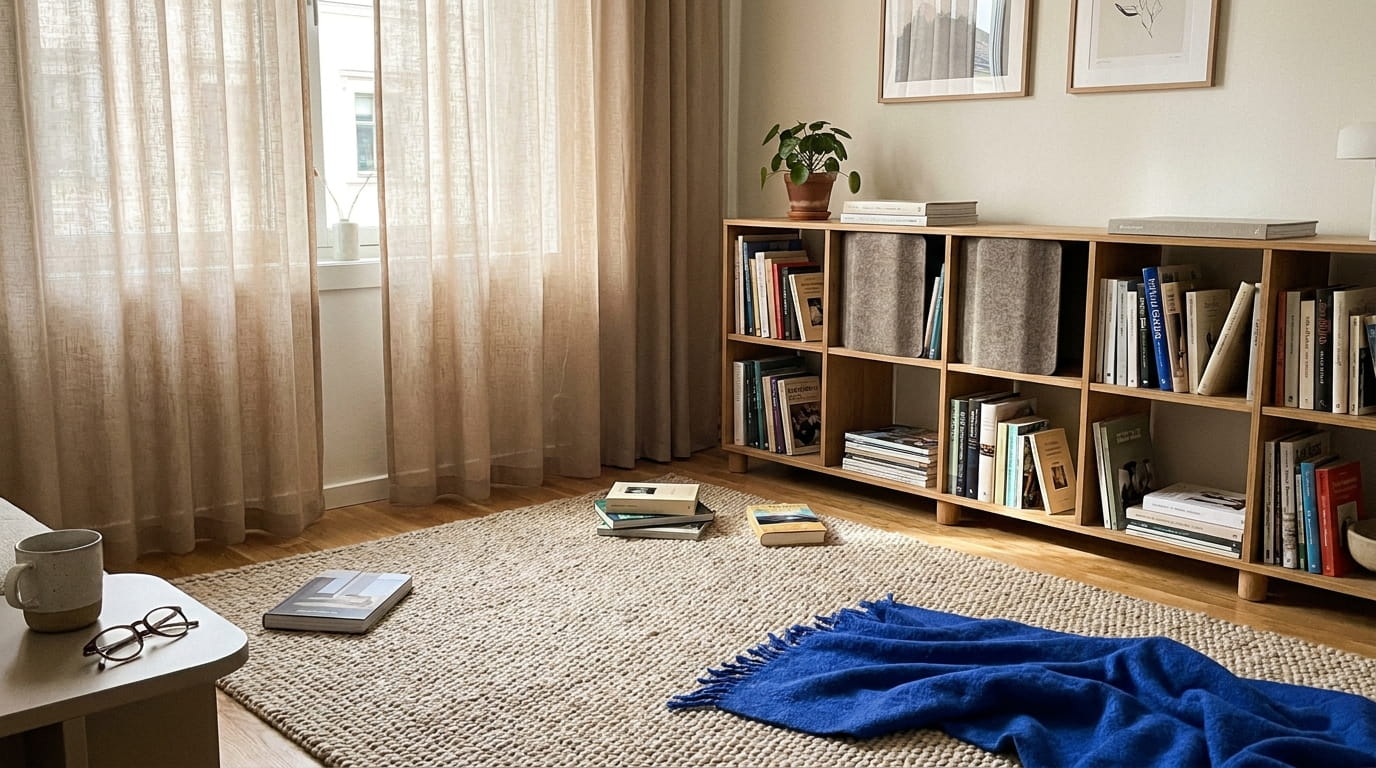
- A thick rug with a dense pad. Big for absorbing sound in your room and for softening your own footsteps for the neighbor below. The pad matters as much as the rug.
- Heavy floor-to-ceiling curtains. They cut a real amount of street noise at the window — and double as the thermal curtains from our guide to lowering the energy bill. One purchase, two problems.
- A packed bookshelf on the shared wall. Mass blocks sound, and a full wall of books is dense, irregular, cheap mass you may already own.
- Upholstered furniture and textiles. A fabric couch, wall hangings, even a quilt on the wall soak up reflections that bare drywall bounces around the room.
Mass and soft fabric block sound; the foam panels mostly just look like you tried.
Seal the gaps sound sneaks through
Sound behaves like water: it pours through any opening, and the biggest opening in most apartments is the gap under the front door. A door sweep or a draft-blocker snake closes it for a few dollars — and since these are the same products the Department of Energy recommends for air sealing, the fix pays twice, in quiet and in heating costs. Weatherstripping tightens rattly doors and windows the same dual-purpose way, and removable sealant along gaps where trim meets wall peels off cleanly at move-out. On a shared wall, the outlets and switch boxes are small uninsulated holes straight through to the neighbor; foam outlet gaskets behind the cover plates cost pennies, install with a screwdriver, and close one more path for both sound and drafts.
Windows are the other major leak, and old single-pane units are nearly open holes for traffic noise. The renter-grade fix is a removable window insert — a clear acrylic panel that presses into the frame with a foam gasket and pops out when you move. Inserts are not cheap, but for a bedroom facing a busy street they are the closest thing to a real window upgrade a landlord cannot object to. None of the sealing steps is dramatic alone; together they stop a one-inch gap from undercutting everything the rugs and curtains do.
When you cannot block it, cover it
For noise you cannot stop — upstairs footsteps, the bass from the bar below — the answer is masking, not blocking. The brain alerts on changes against silence, so a steady neutral background sound smooths intermittent spikes into the wallpaper. The evidence is decent: among studies the Sleep Foundation reviews, one found people fell asleep 38 percent faster with white noise, and steady sound improved sleep in noisy hospital environments, though results vary person to person.
The hardware is cheap. A dedicated white-noise machine runs $20-50; a box fan does the same job for less if the airflow does not bother you; phone apps work with the volume kept modest — masking should sit just above the intruding noise, not become a new noise problem of its own. For the worst nights, soft foam earplugs — a few dollars a box — knock the edge off in a way no rug can. Fan for ambient masking, earplugs for emergencies, is a combination that has rescued a lot of sleep under loud ceilings.
What works and what is a waste
Moving into a loud rental tomorrow, this is the spending order with the best evidence behind it: a thick rug with a real pad, heavy curtains, a door sweep, a packed bookshelf on the shared wall, and a white-noise machine. Every item is reversible, moves with you, and addresses a specific path the sound takes.
What to skip: acoustic foam for neighbor noise, thin "soundproofing blankets" that barely outperform a regular quilt, and anything whose listing promises to "soundproof" a rental — a word doing a lot of lying in product copy. And try the cheapest fix of all first: a polite conversation. Most people genuinely do not know how far their bass carries, and one friendly request solves more late-night noise than any purchase. You cannot weatherstrip a difficult human, but it costs nothing to find out whether yours is one. If the conversation fails and the noise is chronic, check your lease and local ordinances — most cities have quiet hours, most leases have a quiet-enjoyment clause, and a documented, polite paper trail to the landlord resolves more disputes than tenants expect.
Set expectations honestly: a rental never goes silent, and chasing silence is how the money gets wasted on products with "soundproof" in the title. The goal is taking the edge off — fewer wake-ups, lower background stress, a room that feels lively instead of unlivable. Mass on the walls, a sealed door, soft surfaces, and a steady hum by the bed get you most of the way there, with the deposit intact.
Sources & further reading
- How Noise Can Affect Your Sleep Satisfaction — Sleep Foundation
- Noise and Hearing Loss — CDC / NIOSH
- Air Sealing Your Home — U.S. Department of Energy, Energy Saver